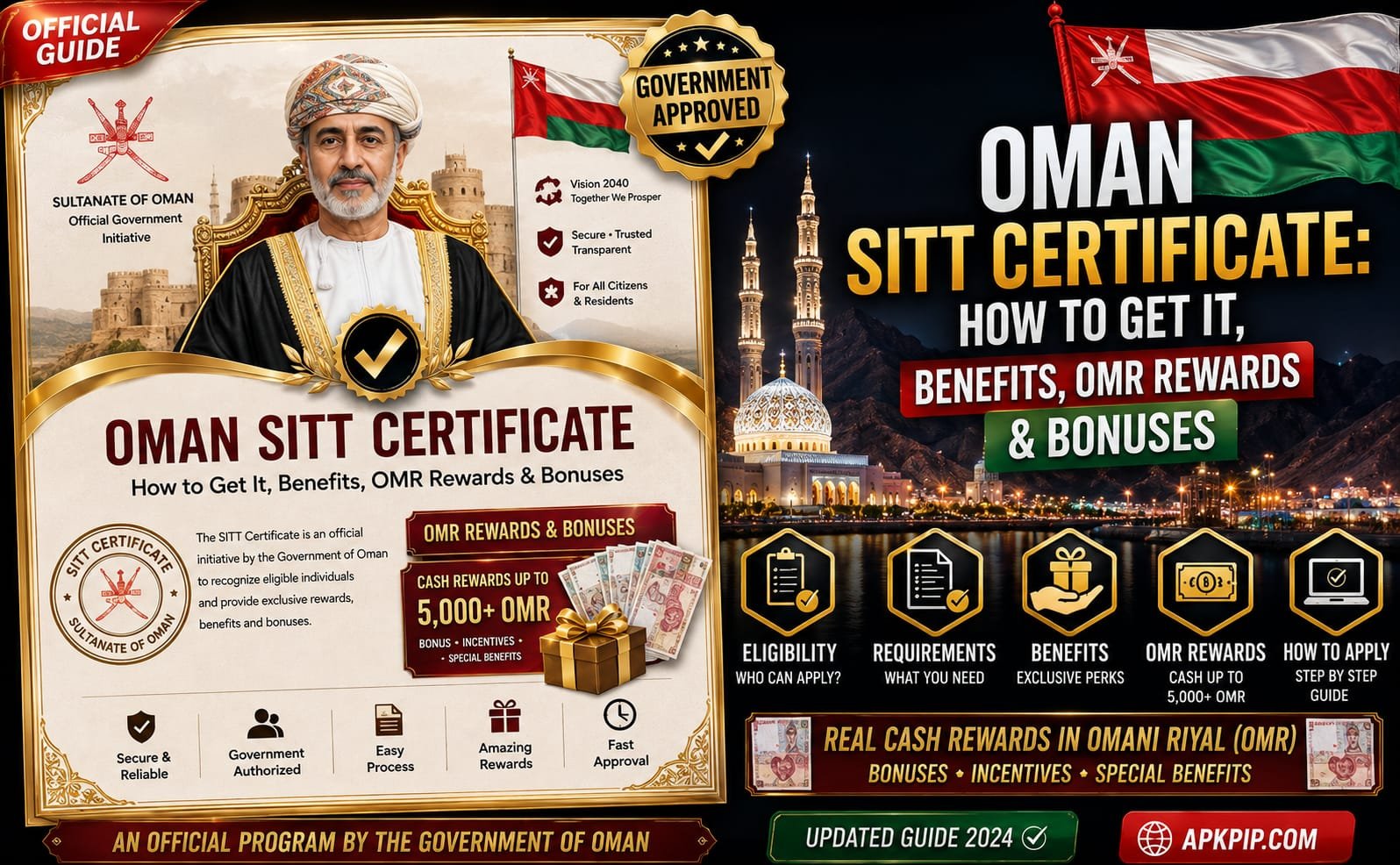
Whether you are here because of a random social media post or WhatsApp message, you are probably now aware of the Oman SITT Certificate. Posts tend to include the same points, for example, it is free, it takes 5 minutes to apply, if your application is approved then you get OMR rewards, or monthly bonuses, or a direct payment to your account. Some include a downloadable app along with the message.
Before we drafted a single word of this guide, the team at info.apkpip, as we do, looked for the source. Not the WhatsApp message. The official source.
We were not able to find it. And that is far more important than any list of “benefits” we could have provided.
This article explains what we checked, what we found, the Gulf scam mentality, and the most important, what you need to do if you provided your information.
What the messages claim
The wording in each post changes, but the offers stay the same:
- Government-backed ‘SITT’ certificate for both Omani nationals and expatriates
- Cash reward between OMR 50 and OMR 500 on approval
- Additional payments every month or quarter as ‘bonuses’
- Preference for employment, salary increment, or an expedited visa process
- Registration through an app or web form, requiring just Civil ID and phone number.
- A deadline, usually within a few days, after which registration will end
You should pause on the last offer, which is a SITT certificate registration. Real government offerings in Oman are announced using official government channels, and have their time-frame announced in advance. These offerings are not posted with a countdown timer on a social media post.
What we checked
We looked at the places a new Omani government offering could potentially be found:
Official government portals. Oman’s national services, the Ministry of Labour, the Royal Oman Police eServices, and Ministry of Foreign Affairs attestation pages. A certificate program that offers cash awards would most likely be found in one of those portals. None of them mention SITT.
Omani media. Times of Oman and Oman Observer—and similar outlets—report on new government activities extensively. There is no coverage on the SITT certificate, in English or Arabic.
Training and certification bodies. Oman has a well-organized certification landscape: OPAL’s unified HSE passport, PDO-approved training providers, the Oman Medical Specialty Board, and MOHERI-licensed vocational institutes. SITT is absent from their course catalogs or lists of accredited training.
General web search, multiple phrasings. We searched for the term on its own, and in combination with “Oman,” “OMR reward,” “safety induction,” and other training and employment-related combinations of terms. The results were all unrelated to what we were looking for, including police clearance certificates, document attestation, HSE passports, or unrelated financial products.
So the best way to describe this is that, at the time of writing this, we can find no evidence that there is an “Oman SITT Certificate” and no evidence that any Omani authority is paying OMR rewards or bonuses in connection with that certificate.
We would rather tell you this than give you false information and an unverified step-by-step guide to apply. If you have an official announcement that we missed, please send it to us, but it needs to be a government website not a screenshot.
Why people fall for this
Oman has a large number of expatriate workers, most in construction, logistics, hospitality, and oilfield services. These workers regularly send money home, and rightly so, pay close attention to things that may provide an incremental amount of money.
These tricks apply to almost all scam messages. The structure rarely changes:
- Act like a Government organization. Add a logo from an existing ministry website.
- Keep your request small. “Just your Civil ID number.” People don’t think they are providing a lot of information.
- Pose an aggressive time limit. This prevents you from thinking through the process logically.
- Show social proof. Forwarded screenshots of completed ‘approvals’ make it more convincing because they are your family and friends.
The acronyms or abbreviations tend to be chosen because they sound closest to real government organizations. In a country where people deal with real abbreviations like PCC, OPAL, MOHERI, and OMSB, an addition of some new capital letters is not an issue.
The processes involved in most scam messages
The end result for these messages can vary, but typically, they follow one of four processes.
Data collection
The end result for most of these messages is usually to collect your information, and you fill out a form. Even if you get an email that says your information was secured and you don’t hear anything again, your information was still likely sold to a criminal to use for identity theft or fraudulent loans in your name.
OTP theft
You are asked to “verify” your account by entering an OTP or one time password. This code was sent to someone because that person is logging into your bank, wallet or WhatsApp. Giving them the OTP gives them access to your account.
The processing fee. After approval comes instantaneously and congratulations are in order as OMR 350 is set aside for you. However, you will find there is a small clearing fee that is charged to you. Should you pay, either the payout is not sent, or a subsequent, larger fee is charged.
The APK sideload. This means you are sent an app that does not exist in Google Play or the Apple App store. Installing the app could result in anything from adware to a program that mining your SMS messages to collect your online banking messages and codes.
Since we run an app review site, we will say it straight: if there is an app that truly disburses government funds, it will exist in the official app stores and will be accessible from official government websites. If the only way to get the app is to directly download the APK from a random WhatsApp group link, that is your answer.
Memorable red flags
Regardless of if its SITT or another acronym, the following are red flags to look for:
- There are no official government websites ending in .gov.om or .om.
- There is no payment without a cost to you.
- They will ask you for one time/authorisation/confirmation passwords, PINs or similar.
- The registration links are shortened URLs or lookalike domains with a slight variation in spelling.
- Contacts use social media, WhatsApp and other non-official channels.
- Communications of this nature would not be approved by a ministry’s communication team.
- Guaranteed approval of everyone, with no exclusion criteria.
- Success depends on you contacting ten others.
There is no clearer indicator to leave it alone. The presence of a couple of the above is a certain sign of a scam.
How to verify any Omani scheme in five minutes (without trusting anyone, including us)
This is a skill worth having, and takes very little time.
Go to the source. Go to Oman’s national services site directly or look for services offered by various ministries. If something is offered, it will be there.
Watch out for URLs. Official Omani government services will use .gov.om and .om domains. Look beyond the displayed text. A site can have any name it wants.
Visit a Sanad service centre. Staff there can assist you in verifying if a government program is valid in less than a minute.
Contact your employer’s HR or PRO department. All requests that involve an employee’s work permit, allowance, or certification are likely to have come across their desks.
Check the Omani media. If a new benefit is available, you would expect it to be covered by Times of Oman or the Oman Observer. Silence in the local news is noteworthy.
Reverse image search the “evidence.” Images of payment receipts and certificates are shared across countries and the currency is swapped out.
If you have already registered
Do not worry about embarrassment — these campaigns are built by professionals. They catch careful people. Act quickly instead.
- If you shared your OTP or banking information, call your bank to freeze your card and online banking immediately. Use the phone number printed on your card.
- If you installed an APK, remove the app, then go to Settings > Apps, and check apps that have SMS, Accessibility, or Device Admin permissions. Consider performing a factory data reset if you use your banking apps on your device.
- If you shared your Civil ID number or Passport number, report it to the authorities. Royal Oman Police take cybercrime seriously and having a report filed helps protect you later.
- If there was a cost, save all of your screenshots, transaction information and call logs and report it. Recovering money is not assured, but reports are what shut systems down.
- Change passwords for all accounts that used that one, and start with your email.
- Inform the group it came from. These messages get around through trust. Breaking that trust helps more than you will ever know.
Actual ways that increase your income in Oman
If you are actually looking for improved work income in Oman, there are genuine ways to achieve that, other than using a WhatsApp form.
- The OPAL unified HSE Passport is used by the oil and gas companies in Oman. It is also a requirement for many site positions. Institutes in Muscat offer this Passport, and it beats online certificates any day.
- Trade and skill tests at vocational training institutes licensed by MOHERI create job documentation from your years of practical experience.
- There are many recognized safety qualifications used in the Gulf such as the NEBOSH. These stay with you and increase your job opportunities.
- It is important to get certificates properly attested. A lot of workers are underpaid because they have good degrees or diplomas that were not done through the correct channels. This is a relatively easy way to increase your income in Oman.
Each of these options require fee payments, and none offer a signing bonus. However, they will successfully increase your overall earnings.
Frequently Asked Questions
Is the Oman SITT Certificate authentic?
We can find no evidence to support its existence. No government agency in Oman has referenced it, and nor has a credible Omani training provider or media organization.
Does the government of Oman pay OMR rewards for certificates?
Not as described in these messages. In Oman, rewards are disbursed through published, protected programs with defined criteria. The reward is not disbursed through an app registration.
A friend sent me the link, does that make it more legitimate?
No. Trusted forwarding is the cornerstone of these campaigns. Your friend has not received a reward.
What if SITT is launched later?
It will be announced on a government website in Oman and will be reported in the press, if and when it is launched. We will update this page as well at info.apkpip.
The Final Word
We could have made our own detailed guide with descriptions of the requirements and program parameters along with rewards amounts. This would have also have ranked number one, and someone would have provided their Civil ID number because of it.
The honest, brief answer is that there is no legitimate SITT certificate, no rewards attached, and no value in the process. If a message claims that there will be rewards for filling out a form, then that is the reward.
Bookmark info.apkpip, and look here every time you want to register for something similar. If you manage to find an official Omani source that disproves what we have said, share it with us, and we will check it and publicly alter this page if necessary.